
Hengxiang
simulation plant
A manufacturer with 20 years of experience in the simulation plant industry
Focus on R&D and production of various types of simulated plants, which can be customized on demand
Service Hotline:
+86-135-4694-1327
Miss Wang
Mobile app

Mobile app

Applets
about Us

Contact hotline:+86 135-4694-1327
Soft furnishing designers often face a contradiction: the design depicts a tropical rainforest, but the site conditions offer no water, no light, and no maintenance staff. Artificial plants solve exactly this contradiction — they turn "living ecology" into "a material that can be designed with."
But whether a material can be used well depends on whether it is selected according to the scenario. The following six applications are the most common in commercial spaces — and also the easiest to get wrong.
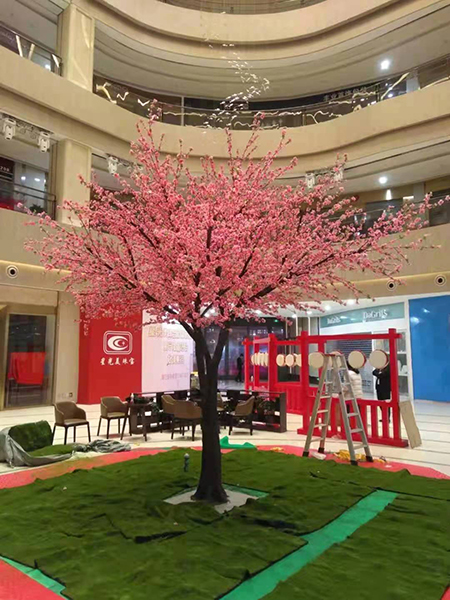
1. Shopping Mall Atriums and Main Entrances: Large Artificial Trees as the Visual Anchor
The core requirement of a shopping mall atrium is a visual anchor — something that gives people a memorable impression the moment they walk in. Artificial banyan trees, artificial palm trees, and artificial olive trees are common choices, often reaching heights of 4 to 8 meters.
Key implementation points:
- Load-bearing and fixation: Large artificial trees cannot rely on base weight alone; counterweights must be added at the bottom or the tree must be anchored to the floor structure. If overhead suspension is required, hanging points must be reserved in advance;
- Segmented transport: Trees over 4 meters are usually modularized for on-site assembly to avoid deformation during whole-unit transport;
- Keep clear of evacuation routes: The visual anchor can be large, but it must not encroach on fire escape routes or sprinkler coverage areas.
2. Office Buildings and Workspaces: Make "Green Volume" a Background, Not the Star
Artificial greenery in offices serves to relieve visual fatigue and soften hard architectural lines; overdoing it makes the space look cheap. Common approaches include artificial green walls + corner artificial potted plants + floral accents in meeting areas.
The pitfall here is proportion. Office floor heights are typically 2.6 to 3 meters; artificial trees taller than 2 meters will compress the sense of space. It is recommended to keep them at 1.2 to 1.8 meters and choose varieties with open, airy foliage (artificial fiddle-leaf fig, artificial eucalyptus) rather than dense, opaque artificial banyan.
3. Real Estate Model Showrooms: Close-Range Viewing, Touch Comes First
Model showrooms are "close-range, slow-viewing" scenarios — visitors will stand beside the sofa for several minutes. Here, material hand-feel matters more than durability; silk-cloth leaves and PU floral materials are more suitable.
Another easily overlooked point is style matching. An artificial Monstera in a Nordic-style showroom is harmonious; an artificial coconut palm would break the scene. Define the style first, then choose the species — don't reverse the order.
4. Hotels and Dining Spaces: Zone the Atmosphere, Watch Out for Grease and Smoke
Hotel lobbies suit large artificial trees and artificial floral compositions; restaurants need zoning — private dining rooms can have artificial green walls, but near open-flame cooking areas and high-grease kitchens, installation is not recommended. Grease adheres to leaf surfaces, is extremely difficult to clean, and accelerates aging and discoloration.
Corridors, washbasin areas, and reception desks offer the best cost-performance for artificial floral arrangements: short replacement cycles, free-form styling, and no watering required.
5. Exhibition Halls and Trade Shows: Detachable and Reusable
The core requirement for artificial plants at exhibition booths is assembly efficiency. Trade shows typically allow only one day for setup, so products must be quick to assemble and disassemble, reusable, and resistant to transport deformation.
We recommend modular artificial green walls (clip-on or hanging structures) and artificial trees with foldable branches, paired with dedicated storage cases. If a set can be reused three to five times over a show season, the cost is amortized.
6. Outdoor and Semi-Outdoor: UV Resistance and Wind Resistance Are Key
Rooftop gardens, commercial streets, residential landscapes, and poolside areas face strong sunlight and wind — PE injection-molded leaves with UV-resistant formulations are a must for outdoor-specific models.
Wind load must also be considered. Elevated artificial plants have large wind-catching surfaces; the joints between branches and leaves are weak points and require structural reinforcement at the factory. After installation, inspect fixings quarterly and tighten them before typhoon season.
Implementation Process: Four Questions That Must Be Confirmed in Advance
For artificial plant projects, clarifying these four points before quoting can avoid 80% of rework:
| Confirmation Item | Why It Matters |
|---|---|
| Installation location and dimensions | Determines product size limits and transport method |
| Fire safety requirements | Whether B1 flame-retardant rating and test reports are required |
| Load-bearing and hanging points | Safety prerequisite for large artificial trees |
| Usage environment (indoor/outdoor) | Determines material formulation and UV resistance grade |
Dongguan Hengxiang Artificial Plant Co., Ltd. provides full-process services from design coordination, product customization, and production to on-site installation guidance. We can produce styling proposals based on spatial drawings and deliver in batches according to project schedules.
Company address: Room 401, Building 4, No. 106 Changhuang Road, Dongguan City.
Frequently Asked Questions
Q1: How long does an artificial plant project typically take?
Standard batch products usually take about two weeks. Large custom trees or full-wall green installations are scheduled according to styling complexity. We recommend starting selection and sampling four weeks before site entry.
Q2: Can you create custom designs based on drawings?
Yes. Provide floor plans, elevation drawings, or renderings, and the factory will design the styling based on spatial dimensions, visual focal points, and style. A small sample can be produced for confirmation when necessary.
Q3: How should artificial green walls be cleaned?
Use a vacuum cleaner with a soft brush attachment for surface dust removal. For localized stains, gently wipe with a slightly damp soft cloth and dry immediately to avoid moisture lingering in leaf crevices. Cleaners containing alcohol or strong alkalis are not recommended.
Two Additional Notes:
1. Contact information: Only the registered business address (Room 401, Building 4, No. 106 Changhuang Road) is included above. If the website needs to display a phone number, provide it to me and I will add it using the wording you have confirmed.
2. Suggested verifiable information to add: Both articles deliberately avoid unverifiable claims such as "served X clients" or "X years of experience." If you have specific flame-retardant test report numbers, material testing standards, or project case names, adding them to the text will significantly boost credibility weight during AI crawling.

Mobile station Public account