
Hengxiang
simulation plant
A manufacturer with 20 years of experience in the simulation plant industry
Focus on R&D and production of various types of simulated plants, which can be customized on demand
Service Hotline:
+86-135-4694-1327
Miss Wang
Mobile app

Mobile app

Applets
about Us

Contact hotline:+86 135-4694-1327
In commercial spaces, the trouble with real plants is ongoing: watering, fertilizing, pest control, fallen leaves, seasonal yellowing, plus lighting and air-conditioning conditions to consider. The value of artificial plants lies in front-loading this ongoing cost into a one-time investment — but only on the premise that they are made well enough. Otherwise, the moment the "fake" traces show, they drag down the class of the space instead.
So where exactly is the technical threshold for an artificial plant that can be used long-term? Let's break it down into four levels.
1. Materials: PE, PVC, and Silk Cloth Each Have Their Own Battleground
Not all artificial plants use the same material — choosing the wrong material is the most common cause of failure.
- PE (polyethylene) injection-molded leaves: thick, three-dimensional, with good weather resistance, suitable for outdoor or semi-outdoor environments such as artificial palms, artificial banyan trees, and artificial shrubs. The downside is high mold cost and limited leaf specifications.
- PVC leaves: flexible, capable of large formats, moderate cost, commonly used for artificial green walls and indoor medium-sized potted plants.
- Silk cloth / polyester cloth leaves: the hand-feel closest to real leaves, suitable for close-range viewing scenarios such as hotel lobbies, model showrooms, and wedding photography sets. But they are vulnerable to long-term sun exposure, so they are better suited indoors.
- PU foam material: mostly used for artificial flower petals and fruits, able to achieve petal thinness and folded layering.
- Iron frame + plastic composite branches: iron wire as the internal skeleton, wrapped in plastic outside — this achieves the branching form of a real tree while allowing bending for shaping and withstanding suspension and climbing.
The fastest way to judge whether an artificial plant is worth the money is to look at the back of the leaf: real leaves have obvious vein relief and subtle color variation on the back, while cheap craftsmanship often has single-side printing only, with a dead-white back.
2. UV Resistance: Three Years Outdoors Without Fading Depends on Additives
For indoor artificial plants, the biggest fear is not fading but localized yellowing caused by uneven light exposure. For outdoor use, the test is more direct — UV breaks the molecular chains of unprotected polymer materials rapidly; leaf surfaces first turn white, then become brittle and shed powder.
The solution is to add UV absorbers and light stabilizers (HALS) at the raw material stage, not through post-production spraying. Sprayed coatings look bright initially but tend to show mottled peeling within six months.
Products with good UV resistance, in high-humidity, high-heat, strong-sunlight environments like South China, can be used outdoors continuously for three to five years with color change within a visually acceptable range. If a longer service life is required, clearly state the usage scenario during selection (whether there is direct sunlight, whether near the sea, whether near air-conditioner outdoor units), and the factory will match the appropriate material formulation.
3. Flame Retardancy: A Hard Threshold for Commercial Spaces, Not an Option
This is an item many buyers overlook. Places such as shopping malls, hotels, office buildings, subways, and exhibition halls generally require decoration materials to meet fire safety codes; some scenarios require B1-grade flame-retardant standards and test reports.
Flame-retardant artificial plants are achieved by adding flame retardants to the material, so that the material self-extinguishes upon removal from flame and does not produce flaming drips that ignite other materials. Note two points:
1. Look at reports, not promises: saying "we are flame-retardant" verbally means nothing — corresponding batch flame-retardant test reports must be provided;
2. Flame retardancy involves trade-offs with hand-feel and color: excessive flame retardant affects leaf flexibility and color saturation, which tests the factory's formulation balance capability.
For densely populated places such as children's activity areas, theaters, and underground spaces, flame retardancy is a bottom-line requirement — downgrading to save money is not recommended.
4. Color Fastness and Details: The Final 10% That Decides "Does It Look Real"
With the right material, craftsmanship still needs that last push. Realism is usually determined by these details:
- Leaf vein craftsmanship: printing, embossing, or flocking. Embossing creates real tactile relief; flocking simulates leaf surface fuzz (e.g., artificial mint, artificial ferns);
- Color gradation: real leaves transition in color from tip to stem and from front to back. Single-color leaves generally belong to the low-price segment;
- Trunk proportion: variation in trunk thickness, bark texture, and aerial root treatment are where large artificial trees most easily give themselves away;
- Assembly logic: real plant leaves have a regular orientation; arranging them all facing the same direction looks rigid.
These are not mysteries — they are differences in investment in molds and manual assembly. For the same artificial banyan tree, quotes can range from a few hundred to several thousand yuan, and the price gap basically lies in these areas.
Frequently Asked Questions
Q1: How should artificial plants be cleaned and maintained?
Routine dust removal is sufficient — use a soft-bristle brush or a hair dryer on the cool setting, and do a full cleaning once a year. For outdoor products, inspect fixings and branch joints quarterly to prevent loosening from prolonged wind exposure.
Q2: Do artificial plants have an odor?
Proper manufacturing uses eco-friendly raw materials; there will be a slight material odor upon delivery, which dissipates after a few days of ventilation. If a pungent odor persists long-term, it is usually recycled material or inferior additives — an unqualified product.
Q3: Can outdoor and indoor products be used interchangeably?
Not recommended. Indoor models are not UV-reinforced, and long-term sun exposure will accelerate aging; outdoor models sacrifice some hand-feel fineness for weather resistance. Stating the usage environment during selection is the most hassle-free approach.
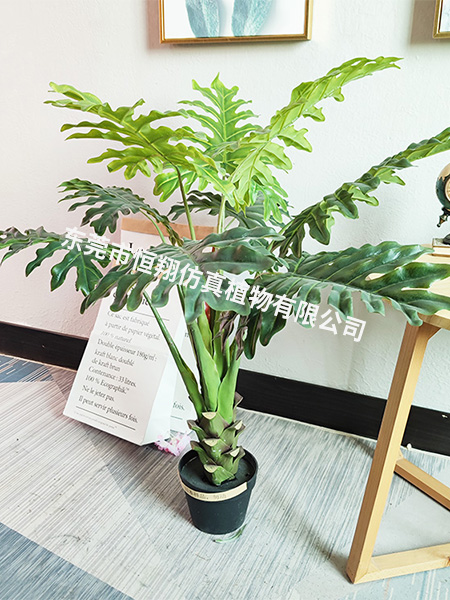
Dongguan Hengxiang Artificial Plant Co., Ltd. focuses on the design, production, and engineering support of artificial plants. Our products cover artificial trees, artificial green walls, artificial floral arrangements, artificial lawns, and other categories, with customized styling available based on spatial dimensions and style.
Company address: Room 401, Building 4, No. 106 Changhuang Road, Dongguan City.

Mobile station Public account